
 Lessons from an Examiner

Critical lessons, common pitfalls, and practical exam techniques to turn your chemical knowledge into maximum marks.
Across various exam papers, from practice exams to the real one, A-Level Chemistry students are often shocked at the difference between their perceived score based on their knowledge, and their actual marks. When they look at their marked scripts, the feedback often isn't “you didn't know the chemistry”, but “you didn't answer the question the way the mark scheme demanded.”
Having spent hours evaluating hundreds of live student scripts, I have seen firsthand where marks are won and lost. Exam boards across the UK, whether you are sitting AQA, OCR, or Edexcel, demand a level of precision that can sometimes feel like playing a unique game!
1. General tips
Examiners mark scripts under strict time constraints and quite rigorous quality control. They are often scanning through all the questions quickly against the mark scheme, only slowing down if errors are found.
- “Benefit of the Doubt” (BOD) is used sparingly: If your explanation is ambiguous, examiners are trained not to guess what you meant. If you write “it has strong bonding” when you should have specified “strong electrostatic attraction between oppositely charged ions”, you will lose the mark.
- Make It Easy to Award Marks: Keep your handwriting legible and your calculations neat. If an examiner has to decipher a tangled web of scribbles to find your final answer as your script is number 57 out of 140, it can be that much harder for an examiner to correctly award you marks.
2. Stop the leak of easy calculation marks
Calculations make up a massive portion of A-Level Chemistry papers, ranging from simple gas volume conversions to multi-step titration, Ka, and buffer solution problems. This is where all students, including those at the top of their game, lose unnecessary marks.
Show Every Step for “Error Carried Forward” (ECF)
If you make an arithmetic error in Step 1 of a 5-mark calculation, you can still score 4 out of 5 marks, if and only if your working out is laid out in a way that the examiner can follow.
- Label your steps clearly (for example, Moles of acid = ... and Moles of excess base = ...).
- Draw a clear line through mistakes rather than scribbling over them. Duplicate answers are very rarely awarded marks, regardless of whether one is correct.
Beware of premature rounding
Never round off intermediate numbers in your calculator during multi-step calculations. Keep the full value in your calculator memory and only round your final answer. Rounding prematurely at Step 2 will compound errors and leave your final answer outside the accepted tolerance window on the mark scheme.
Match your significant figures
Pay close attention to the raw data provided in the question stem. As a rule of thumb, your final answer should be quoted to the same number of significant figures as the piece of data given to the lowest precision in the prompt (typically 2 or 3 significant figures). Always check whether a question explicitly specifies the required significant figures, decimal places, or units. Missing these is a very common place to lose marks!
The sign matters in energetics
When calculating enthalpy changes, entropy changes, or electrode potentials, do be careful with the sign! This is especially important with calorimetry questions (q = mcΔT).
3. Be precise, not vague
Students often hear this a lot! But what does this mean in the context of exam marking? See some examples below:
“Bonds break when melting ice.”
Intermolecular forces (hydrogen bonds) between molecules are overcome.
“Sodium has a bigger radius so it’s less attractive.”
Increase in atomic radius and shielding reduces the attraction between the nucleus and outer electrons.
“The reaction gets faster because particles collide more.”
Increased frequency of successful collisions per unit time with energy ≥ Eₐ.
“The equilibrium shifts to fix it.”
The equilibrium position shifts left to oppose the change (Le Chatelier’s Principle).
4. Decode the command words
Misreading the command word is one of the most frustrating ways to lose marks:
- State / Name / Identify
- Requires a brief answer. No explanation needed.
- Describe
- State what happens step-by-step or what is observed.
- Explain
- Give reasoning or mechanism for why something happens, using chemical principles.
- Deduce
- Use provided data or information to arrive at a logical conclusion. Show the steps you used to get there.
5. Play examiner
Read the exact exam question and the student's response below. Before reading the marking breakdown, decide: How many marks would you award? If they do not score full marks, where did they slip up?
1Exam question
[1 mark]Define the meaning of a ‘transition metal complex’.

Reveal the model answer, examiner's mark, and commentsHide the model answer, examiner's mark, and comments
Model answer
A metal atom or ion surrounded by co-ordinately bonded ligands.
Mark awarded
0 / 1
Examiner's comments
Despite a very good answer by this student, with details even on the co-ordinate bonding, by not stating that it is a metal atom or ion they miss the mark.
2Exam question
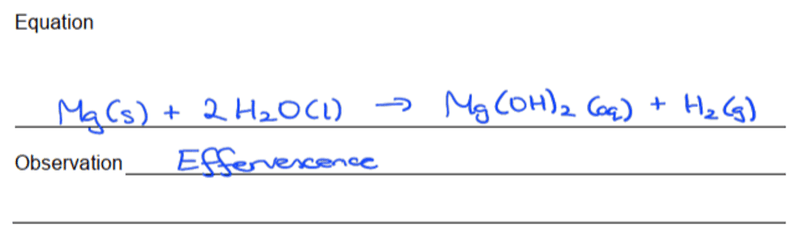
[2 marks]Provide the equation for the reaction of magnesium with steam, and state an observation for this reaction.
Reveal the model answer, examiner's mark, and commentsHide the model answer, examiner's mark, and comments
Model answer
- Equation: Mg + H2O → MgO + H2 (1 mark)
- Observation: Bright white light / white flame / white solid formed (1 mark)
Mark awarded
0 / 2
Examiner's comments
The student has given a correct equation here in terms of the Chemistry. Unfortunately, they have conflated the reactions of magnesium with water and magnesium with steam. Magnesium reacts with steam to form magnesium oxide (MgO), not magnesium hydroxide (Mg(OH)2). Additionally, “effervescence” only occurs when gas evolves from a liquid. Because this reaction occurs between a solid and steam, the observable result is a bright white flame or light, or the formation of a white solid or powder.
3aExam question
[2 marks]The table below shows some enthalpy change data:
| Reaction | Enthalpy change / (kJ mol−1) |
|---|---|
| Ca2+ (g) + 2 Cl− (g) → CaCl2 (s) | −2237 |
| Cl− (g) → Cl− (aq) | −364 |
| Ca2+ (g) → Ca2+ (aq) | −1650 |
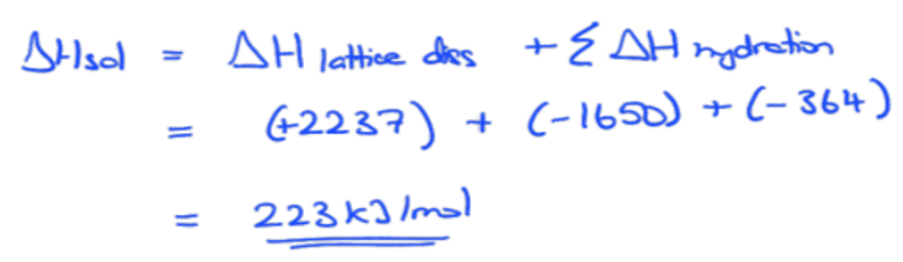
Using the data provided, calculate the enthalpy of solution for CaCl2.
Reveal the model answer, examiner's mark, and commentsHide the model answer, examiner's mark, and comments
Model answer
- M1, working: ΔHsol = +2237 − 1650 − 2(364)
- M2, final answer: −141 kJ mol−1 (1 mark for correct working, 1 mark for answer)
Mark awarded
0 / 2
Examiner's comments
The student here has not taken into account the formula of CaCl2, whereby two moles of chloride ions are produced per one mole of salt. Therefore, the hydration enthalpy of chloride must be multiplied by 2. It does not matter that their calculation uses the right numbers in the right order.
3bExam question
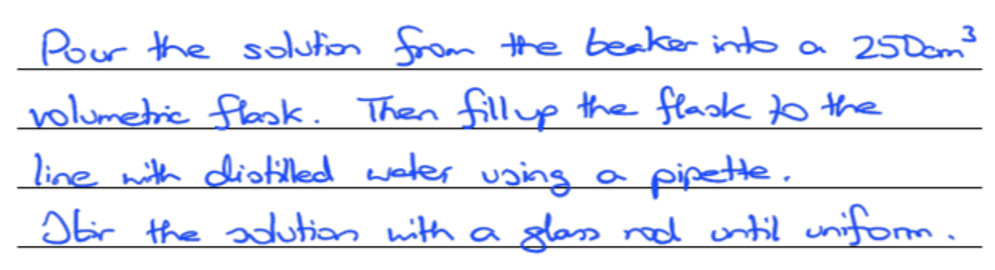
[3 marks]A student wishes to create a sample of calcium chloride by dissolving this in a beaker with 200 cm3 of distilled water. Describe how this solution is used to create a 0.1 M solution of calcium chloride at a volume of 250 cm3.
Reveal the model answer, examiner's mark, and commentsHide the model answer, examiner's mark, and comments
Model answer
- Transfer the solution to a 250 cm3 volumetric flask. (M1)
- Rinse the beaker and rod with distilled water, adding all washings to the flask, and fill with water until the bottom of the meniscus is level with the volume marking. (M2)
- Invert or shake the flask multiple times to mix thoroughly. (M3)
Mark awarded
1 / 3
Examiner's comments
This answer is partly right. They score one mark for transferring their initial solution into a 250 cm3 volumetric flask. However, the student then omitted rinsing the beaker and crucially adding these washings to the flask before making up the 250 cm3 solution with distilled water. They also didn't mention inverting the flask to ensure thorough mixing. Otherwise, sediment could sink to the bottom, or the concentration may not be equal throughout the solution, for example.
4Exam question
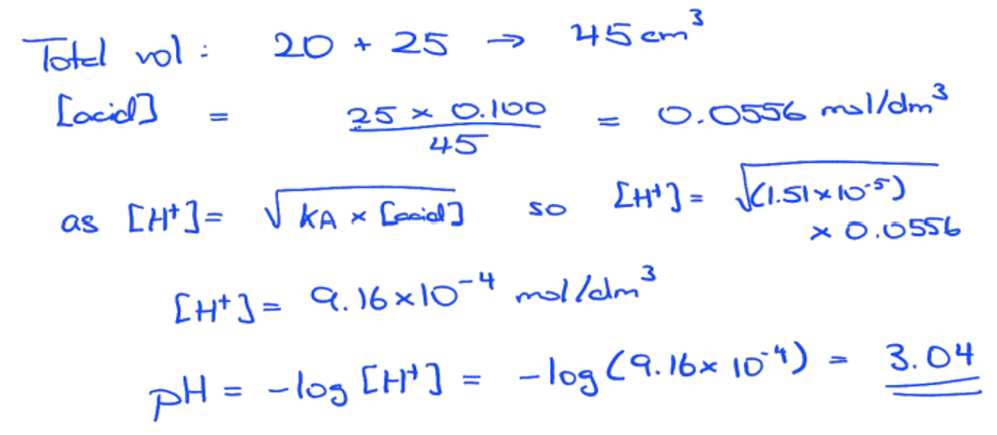
[5 marks]Calculate the pH of the solution formed when 20.0 mL of 0.1 mol dm−3 solution of potassium hydroxide is added to 25.0 mL of 0.1 mol dm−3 solution of butanoic acid.
Ka of butanoic acid = 1.51 × 10⁻⁵ mol dm−3
Reveal the model answer, examiner's mark, and commentsHide the model answer, examiner's mark, and comments
Full-mark model answer
- Initial acid: 0.0250 × 0.100 = 2.50 × 10⁻³ mol
- Initial base: 0.0200 × 0.100 = 2.00 × 10⁻³ mol
- Excess acid: This is therefore 0.50 × 10⁻³ mol
- [H+] expression: [H+] = (Ka × n(acid)) ÷ n(salt) = ((1.51 × 10−5) × (5.00 × 10−4)) ÷ 2.00 × 10⁻³
- Final pH: −log10(3.775 × 10⁻⁶) = 5.42
Mark awarded
0 / 5
Examiner's comments
Crucially here, the student failed to recognise that mixing a weak acid with a strong base forms an acidic buffer solution, and therefore they could not use the weak acid approximation ([H+] = √(Ka × [acid])) once the KOH has neutralised some of the acid. This had to be calculated by working out the initial moles of both species, working out what is in excess (here it is the acid), and then using this to determine the moles of salt formed. Due to the incorrect expression for [H+], no ECF marks can be awarded here.
Unlock your potential with LiteLearn
Mastering A-Level Chemistry requires a dual approach: building a deep understanding of core chemical concepts and sharpening your exam execution to match what examiners look for.
At LiteLearn, our specialised Chemistry tutors break down complex topics into clear, manageable steps while training you directly against exam board mark schemes. Whether you want to master organic mechanisms, conquer calculations, or refine your exam technique, we are here to help you achieve the top grades.
Ready to transform your A-Level Chemistry performance? Explore our expert 1-on-1 tuition programmes at LiteLearn today.