


A one-hour tutoring session feels so normal that we rarely question it. It’s just how tutoring works – or so we assume. But when you pause and really think about it, the question becomes unavoidable: why do we default to one-hour tuition?
For decades, this has been the standard. However, looking more closely, it becomes clear that this format was not designed with a student’s learning in mind! Traditionally, tuition was strictly an in-person affair; a tutor had to travel to a student’s home, or a parent had to drive their child to a tuition center. With the commute, the packing and unpacking of bags, and the disruption to evenings or weekends, anything less than an hour just didn’t make sense. Sixty minutes became the minimum time to make the journey ‘worth it’ for both the tutor and the family. Fundamentally, we were organizing education around logistics rather than prioritizing the best format for learning.
However think about how dramatically our daily lives have changed. Nowadays there’s no need to rush through family dinners, battle rush-hour traffic, or sit in waiting rooms just to get some extra help. A student can easily open a laptop or tablet at the kitchen table, or during a break at school, and connect with an expert in seconds. Technology has completely erased those old logistical hurdles that once dictated how we learn.
This shift from analogue to digital has unlocked a massive opportunity: without the constraints of travel, we can finally design tuition models based purely on how the brain absorbs information – centered around how students learn best! This technology makes highly targeted, flexible formats (like the 20-minute sessions we use here at LiteLearn) possible. The real question then is, what format actually works the best?
To answer that, we have to look at how the human brain processes new information.

What cognitive science tells us about attention
When a student sits down to learn a complicated new maths principle, or a tricky biological process, they are relying on their working memory. Think of this as acting like a bucket; it can only hold so much water at any one time before it overflows. Over the course of one hour, with several principles stacked on top of each other, students can often find that bucket overflowing around the 25- to 30-minute mark.
The student might still be nodding along and staring at the screen, but active learning has ground to a halt. The remaining half-an-hour then becomes merely an exercise in endurance. In educational psychology, this is known as Cognitive Load Theory.
Further to this, the late 19th-century psychologist Hermann Ebbinghaus discovered that humans forget newly learned information at an alarming rate unless it is reviewed effectively; his research led to the concept of "The Forgetting Curve" [1].
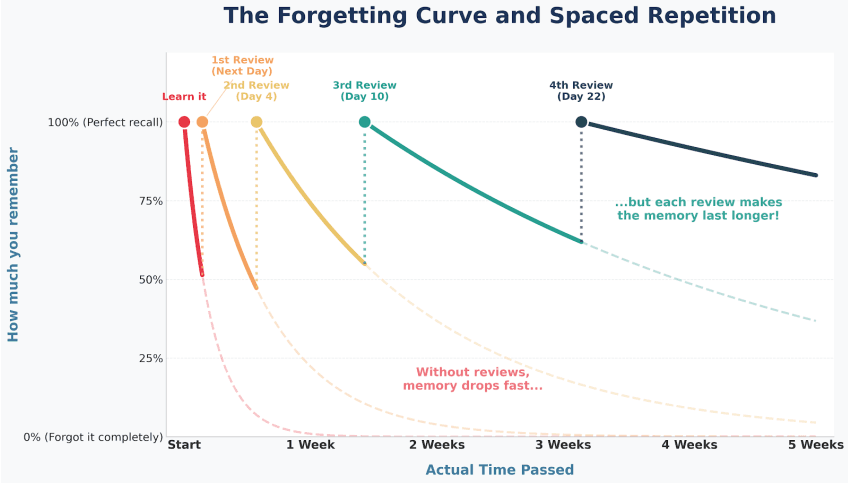
While this rapid loss of information may feel like a frustrating flaw in how we learn, or a sign of a struggling student "just not making sense" of it, it is actually a vital feature of our evolutionary biology. From a survival standpoint, the human brain is designed to be ruthlessly efficient. It is hardwired to remember threats, or highly emotional events (like the location of a predator, or a dangerous environment). That kind of information triggers our amygdala and is immediately imprinted into our memory as it keeps us alive.
However, abstract information, like a subtle algebraic manipulation, doesn’t trigger that same biological alarm system. As the brain consumes a massive amount of our energy, it constantly performs cognitive housekeeping to stay efficient. If new information isn’t tied to an immediate survival need, or if it isn’t repeatedly encountered, then the brain actively prunes those neural connections. This natural, biological process is exactly what Ebbinghaus mapped out; and since we cannot (and definitely should not) make tutoring a stressful scenario to trigger this survival response, we have to work to the brain’s natural rhythm. Fortunately, modern cognitive science has demonstrated that we can ‘trick’ the brain into realizing that this abstract information is important by spacing it out into shorter, highly concentrated, frequent bursts.
This is where time-management systems, like the famed Pomodoro Technique [2], become incredibly valuable for education.
Why short, focused sessions actually work
Originally developed in the late 1980s, the Pomodoro Technique is built around 25-minute bursts of hyper-focused work, separated by short breaks.
To understand why this is so effective, we have to take an honest look at the anatomy of the traditional one-hour tutoring sessions. While parents pay for 60 minutes of learning, they rarely (if ever) get 60 minutes of active learning.
Think about how that hour actually unfolds:
- Minutes 1-10: The student is settling in, exchanging pleasantries, resolving technical issues, searching for the information they want to cover.
- Minutes 10-30: This is the core active learning phase where the student’s working memory is engaged, and the tutor can introduce new concepts, or reinforce old ones.
- Minutes 35-60: Cognitive load reaches its peak; the student begins to subconsciously pace themselves to survive the remainder of the hour. Eyes begin to glaze over, attention begins to drift and tiredness ensues.
In this industry this 'filling time' is often referred to as padding. Neither the student nor the tutor is doing it maliciously; it is just human nature to stretch a 25-minute task to fill a 60-minute time slot. By contrast, what happens when we compress that timeline? At LiteLearn, we’ve adapted the Pomodoro concept into 20-minute, hyper-focused tuition blocks backed by recent research [3] into micro-learning. When both the tutor and the student know they only have 20 minutes, the padding disappears and the session begins with immediate intention, capturing the peak of the student’s attention span, and concludes before reaching the cognitive load limit and fatigue sets in.
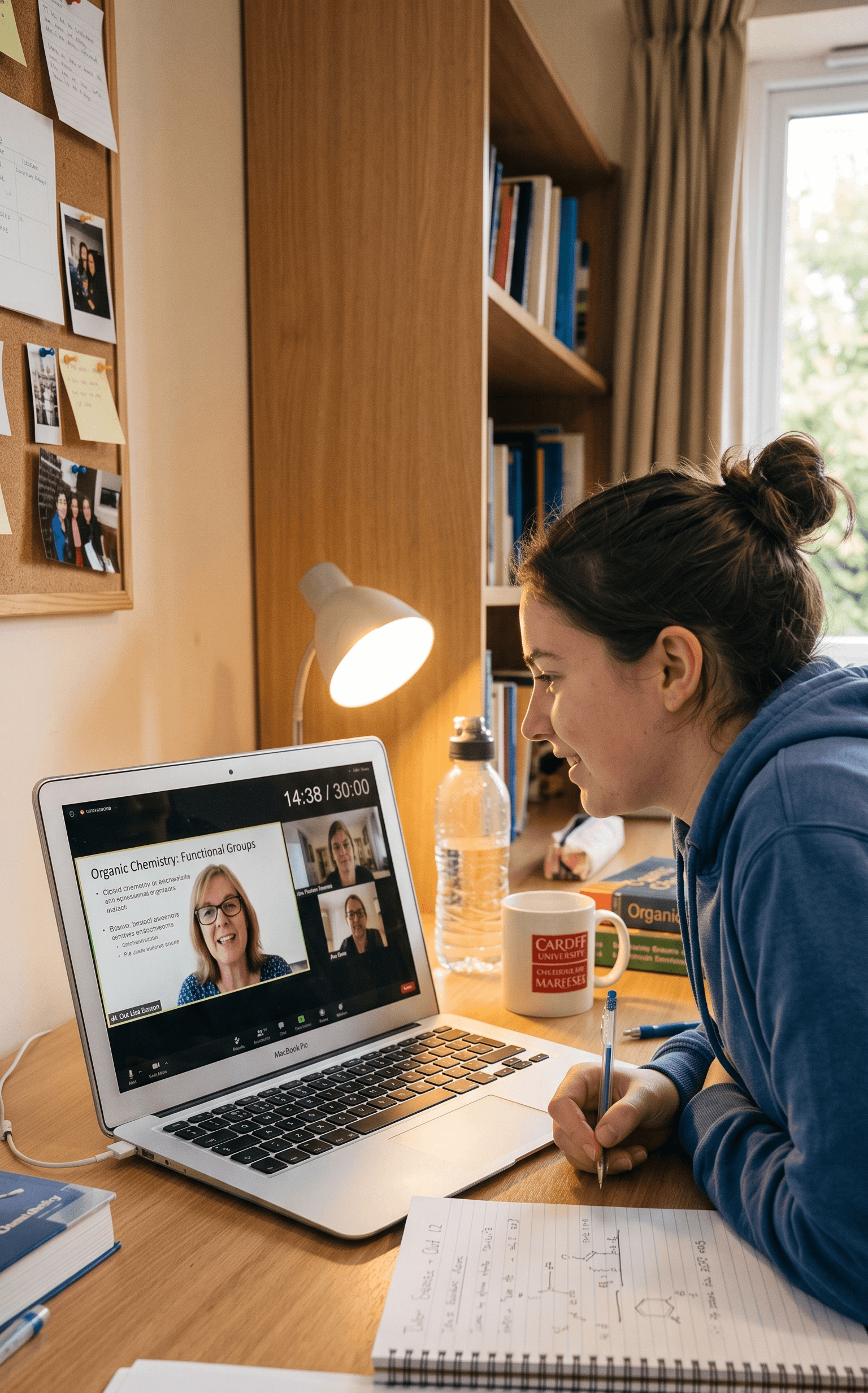
But how does a 20-minute session actually look in practice?
When we strip away the small talk, the settling in, and the debriefing time inherent in a 60-minute session, we are left with only active learning. Here are just a few ways this micro-learning model works in reality:
- The Homework Hurdle: A student gets stuck on a specific calculus problem, or a difficult chemistry equation, waiting days for a scheduled hour-long appointment completely stalls their momentum. Instead, they can jump into a 20-minute targeted sprint. The tutor unblocks the problem, ensures the student grasps the underlying concepts, and the student immediately gets back to their day.
- The Concept Deep-Dive: Rather than trying to cram an entire module into one sitting, a 20-minute session tackles one isolated concept at a time. This single-focus approach prevents the working memory bucket from overflowing.
- The Spaced Repetition Review: To actively combat the Forgetting Curve, students can use 20-minute sessions as rapid-fire reviews of past topics. These short, frequent review points signal to the brain that the information is important, successfully transferring it into long-term memory without causing too much burnout.
- Eliminating the Pre-Study Battle: From a purely practical standpoint, it is incredibly difficult to convince a tired student to log on for an hour of extra maths after a long school day. The psychological barrier is massive. But a 20-minute session before dinner? The resistance drops immediately as the timeframe feels fast, manageable, and painless. Students are much more willing to show up with a positive attitude.

For too long we’ve measured educational value by the amount of time a student spends sitting at a desk. However, a ticking clock doesn’t guarantee active, high-quality learning. The 60-minute session was built for the logistics of the past, and today we have the tools to build tuition around the biology of the brain. By shifting the focus to 20-minute sessions, we eliminate the padding, flatten the Forgetting Curve, and give students their evenings, and their confidence back. At LiteLearn, we’ve stopped asking students to endure the hour. It’s time to make every minute count.